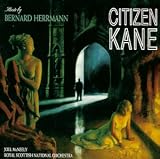
- Prelude
- Susan In Night Club (Rain Sequence)
- Thatcher Library (Litany) Ms Reading And Snow Picture
- Galop
- Dissolve To Thatcher Second Ms Bernsteins Narration
- Kane's News Office Carter's Exit Chronicle Scherzo
- Bernstein's Presto
- Kane's Return Valse Presentation
- Sunset Narrative
- Theme And Variations (Breakfast Montage)
- Kane Meets Susan Susan's Room Mother Memory
- The Trip To Susan's Gettys' Departure Kane Marries
- Salaambo's Aria (Rosamund Illing Soprano)
- Leland's Dismissal
- Susan In Night Club (New Dawn Sequence)
- Opera Montage (Rosamund Illing Soprano)
- Xanadu Jigsaw Puzzles (Perpetual Motion) Second Xanadu
- Kane's Picnic Susan Leaves
- El Rancho (Second Dawn Sequence)
- The Glass Ball
- Finale
発売日:2011年5月24日(火)
レーベル:Imports
レビュー (Amazon)The story behind the creation of
Citizen Kane (1941) is the stuff of legend: it is the tale of how Orson Welles, a theatrical boy genius in his mid-20s, came to Hollywood with the promise of total artistic freedom and responded by creating the greatest film ever made, only to see both the film and his career destroyed by the parochial Hollywood establishment. Welles' bravery extended to his hiring of Bernard Herrmann, who repaid Welles's faith with an eclectic, groundbreaking score that set a new standard for quality and diversity. The composer applied his radio training in various parts of the score, complementing the sharp photographic contrasts of Gregg Toland with economic bridging devices. Herrmann also deployed traditional classical forms and styles in
Citizen Kane: a four-note brass motif represents Kane's power, while a second motif for vibraphone is associated with the mystery of "Rosebud." Then there is "Salammbo", an evocation of 19th-century Franco-Oriental opera written for Kane's wife Susan Alexander. The subterranean, eerie music for the Xanadu estate bookends this classic disc, which should be cited anytime one wishes to make an argument for film music as an artistic rather than a commercial medium.
--Kevin Mulhall